Pakistan’s Foreign Policy Towards Junagarh and Manavadar
(M.Sbn.A)
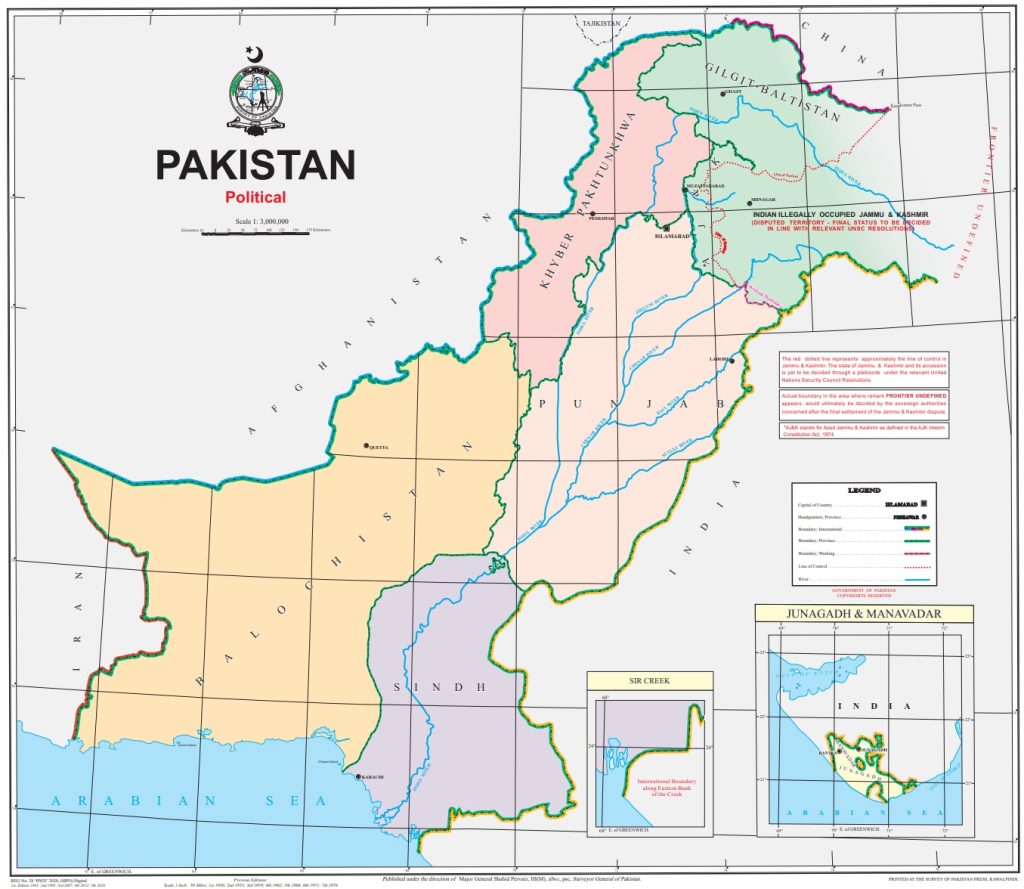
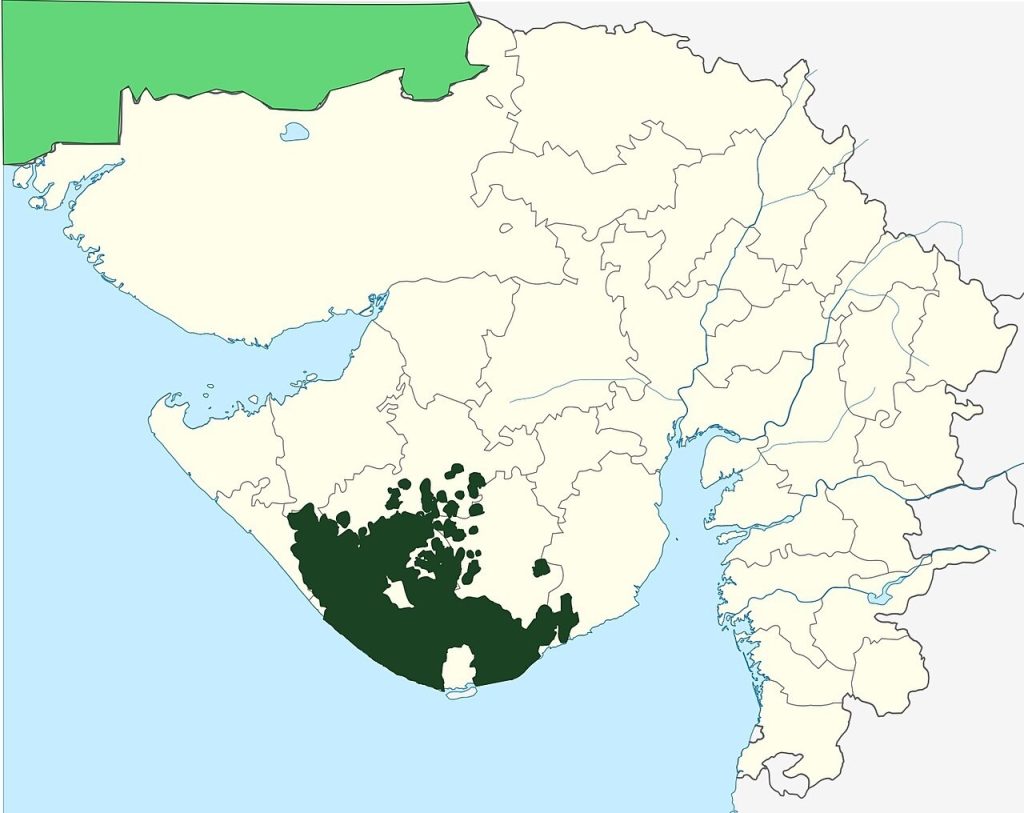
In 2020, Pakistan unveiled its new official map, which, among other things, prominently featured Junagarh and Manavadar as parts of the country. Although this has been Pakistan’s longstanding practice, there was much hue and cry from the Indian side over this, despite the fact that the map was actually in response to an Indian map which featured the whole of Jammu and Kashmir and Gilgit Baltistan (including the parts administered by Pakistan) as belonging to India. This begs the question: what is this dispute all about?
Background
The 3rd June Plan of 1947 envisaged the creation of 2 new independent Dominions out of the British Raj: Pakistan and India. The scheme was thus: the provinces proper of the British polity were to decide via their elected legislatures which of the new states they wished to join, with an added provision for partitioning Punjab and Bengal, where there was severe disagreement. As for the 560 or so “Princely States” in the Indian Subcontinent, under the suzerainty of the British Emperor of India through his Viceroy, the same formula gave 2 options: accession to either of the 2 new Dominions via a legal tool called the “Instrument of Accession”, or independence. This last option was, however, rarely allowed to be exercised by either of the new powers, and most states peacefully passed under the control of either of the Dominions, primarily based on their geographical contiguity or religious demographics.
This was not the case, among a few others, with the 2 princely states of Junagarh and Bantva-Mandavadar. Both had Hindu populations in the majority, but their Muslim rulers opted for Pakistan. Interestingly, around the same time, the Maharajah of the Muslim-majority princely state of Jammu and Kashmir also allegedly opted for India. This, therefore, created a situation where the accessions of the princely states, while being perfectly legal, were contrary to the principles of the partition (that Muslim-majority areas should go to Pakistan, and others to go to India). Both India and Pakistan asserted their claims to all these states, with varying forcefulness. India’s actions, in particular, favoured military use, knowing full well her advantages in that area at that time over Pakistan. In the case of Kashmir, India acted on the principles of the Instrument of Accession and put boots on the ground in that state to assert her claim, whereas Pakistan expounded the principles of the partition to stake a claim. The reverse happened in Junagarh, where India refused to accept the Instrument of Accession, and put boots on the ground there as well.
Pakistan’s Foreign Policy vis-à-vis Junagarh and Manavadar
For Pakistan, coming into existence as a homeland for the Muslims of the subcontinent, the accession of the 2 states of Junagarh and Manavadar meant more as an opportunity to advance her claims towards Jammu and Kashmir, rather than taking their Accession documents seriously. While the principle of contiguity, which India also added in her list of reasons for not recognizing Junagarh’s Accession to Pakistan, can easily be refuted if one remembers that Pakistan at that time had an eastern wing as well, separated by an even greater distance of 1600 miles, the more significant factors for Pakistan’s strategic calculus was the non-viability of permanently holding onto Junagarh due to its population’s religious affiliation and India’s military strength, and the more pressing issue of Kashmir, which was seen as a lifeline for Pakistan (seen in the present day in the flow of rivers into Pakistan from that region).
Seen from a constructivist lens, however, the issue was deliberately sidelined by Pakistan in order to bargain better for the territory she framed as an integral part of her identity (the “K” in Pakistan stands for Kashmir). This, despite the fact, from a legal perspective, Pakistan’s position was, and remains strong: there is no provision under the 3rd June Plan (the only legal document defining what the territories of the 2 new Dominions were to look like) allowing for the violation of the Instrument of Accession except by the normal recourse under international law: a mutual agreement to that effect between the affected states. As no such agreement has taken place between India and Pakistan, technically, the 2 territories are still a part of Pakistan.
“From a legal perspective, Pakistan’s position was, and remains strong: there is no provision under the 3rd June Plan (the only legal document defining what the territories of the 2 new Dominions were to look like) allowing for the violation of the Instrument of Accession”
The consistent policy of Pakistan with respect to these 2 states, therefore, has been to delegitimize India’s actions in Kashmir; if India can seize them due to their majority Hindu populations despite the Instrument of Accession being signed, why can’t Pakistan have Kashmir due to its majority Muslim population? This dichotomy of action India deliberately sidelined and avoided answering over the years. The publication of new maps has not changed Pakistan’s consistent policy over the years.
Moreover, over the years, the status of Kashmir changed. When India approached the United Nations in 1948 to arrange for a ceasefire, it voluntarily allowed the purported Instrument of Accession to lapse and be replaced by a new framework that governed the status of Kashmir, under the principle of lex posterior derogat priori (the newer law overrides the earlier law). That was the UN Security Council Resolution 47, which stated that Jammu and Kashmir was a “disputed” territory. This altered the dynamics: any previous Indian claim of still insisting on the validity of the Maharaja’s Instrument of Accession was no longer valid. The Simla Agreement of 1972 also did not revert the original status of Kashmir, merely suggesting that all future disputes be resolved bilaterally. All this while the Instruments of Accession of Junagarh and Manavdar remain intact.
Possible Solutions to the Deadlock
Pakistan has consistently followed her foreign policy objectives in the pursuit of her relations with other states in the international system. This is reflected in her approach to Junagarh and Manavadar, and Kashmir as well. However, signalling and constructing narratives are as potent a force as actual material advantage. As the actual legal scenario in the case of Junagarh and Manavadar is quite detached from that of Kashmir, perhaps it is time to see things differently. In the light of Pakistan’s recent spotlight in international affairs in the aftermath of the US-Israel-Iran War of 2026, she may opt for a more vocal reassertion of her legal claims on the territories under Indian occupation.
The end result, though, will always follow the natural course of Pakistan’s foreign policy principles as enshrined in Article 40 of her Constitution (of 1973, the present one in force), rather than any opportunistic territorial aggrandizement, and the matter will likely only be resolved through dialogue with India.